Sigma Aldrich: imprinted polymer SPE (SupelMIP) #
Introduction #
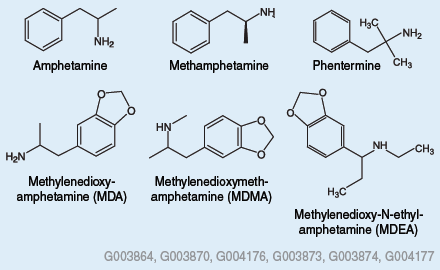
Amphetamine and amphetamine related drugs consist of a class of stimulants and hallucinogens. In recent years, a variety of screening/detection techniques have been commercially available such as ELISA and other immuno-based colorimetric and point of collection (POC) kits/devices. Although such assays are fast and efficient, many of which are typically not class-selective and will only detect some amphetamines and not others (3). Or, some immunoassays are not selective enough and recognize such a wide range of sympathomimetic amines, the positive predictive value (PPV) can range from 0-90% (4). In either case, an alternative and highly selective class-specific confirmation assay is required to verify immuno-based screening results.
A simple, fast and class selective method is developed for trace extraction of amphetamine related drugs from urine samples using a molecularly imprinted polymer SPE (SupelMIP™) specifically designed for selective extraction of amphetamine related drugs (Figure 1). The SupelMIP technique is also compared against a recently published extraction technique using a conventional hydrophilic polymer SPE phase (5).
When compared to a recently published conventional hydrophilic polymer SPE method, the SupelMIP method offers reduced ion-suppression and achieved lower LOQs/LODs by an order of magnitude. The highly selective SupelMIP method also offered increased recovery and reproducibility for better sensitivity, precision and accuracy.
Extraction #
SupelMIP SPE- Amphetamines Method |
Published Amphetamine Method Using Conventional Hydrophilic Polymer SPE Phase (5) |
|---|---|
Sample Pre-Treatment |
Sample Pre-Treatment |
Human urine samples were spiked with internal standard (methamphetamine-d8 and MDMA-d5) and diluted 1:1 (v/v) with 10mM ammonium acetate (NH4Ac) buffer, pH 8.
|
Human urine samples were spiked with internal standard. Spiked and blank urine acidified with 100 µl 5 M HCI per 10 mL urine.
|
SupelMIP SPE - Amphetamines, 25 mg/3 mL (53228-U)
|
Conventional Hydrophilic Polymer SPE Phase, 30 mg/1 mL
|
Column: |
Ascentis C18, 15 cm x 2.1 mm, 5µm particles, (581304-U) |
|||||||||||||||||||||||||||
Instrument: |
Shimadzu LC-20/Applied Biosystems/MDS SCIEX APl3200 |
|||||||||||||||||||||||||||
Mobile Phase: |
Solvent A - DI Water + 0.05% TFA
|
|||||||||||||||||||||||||||
Gradient: |
Initial: 90% A - 10% B
|
|||||||||||||||||||||||||||
Temp.: |
Ambient |
|||||||||||||||||||||||||||
Flow Rate: |
0.2 mL/min |
|||||||||||||||||||||||||||
Ion Mode: |
Positive |
|||||||||||||||||||||||||||
Ion Source: |
Turbospray |
|||||||||||||||||||||||||||
Ion Spray Voltage: |
5500V |
|||||||||||||||||||||||||||
Source Temp.: |
600 °C |
|||||||||||||||||||||||||||
Collision Gas: |
6 psi |
|||||||||||||||||||||||||||
Inj.: |
20 µl |
|||||||||||||||||||||||||||
Det.: |
MS-MS |
|||||||||||||||||||||||||||
MRM transition and retention times: |
|
Lower LOQ #
The lower limit of quantitation (LLOQ) for each analyte was estimated for both the SupelMIP SPE and conventional hydrophilic SPE methods (signal to noise ratio of 10:1) and summarized in Table 3. Using the SupelMIP method, LLOQs in the range of 2.5 – 43.0 pg/mL (an order of magnitude lower than the conventional hydrophilic polymer SPE method) were achieved.
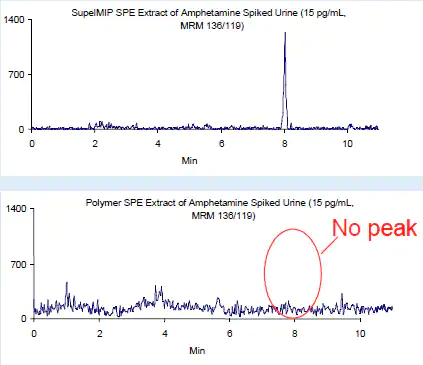
To further illustrate the high selectivity achieved using the SupelMIP SPE extraction method, urine was spiked with 15 pg/mL amphetamine and extracted/analyzed as above. An amphetamine peak was easily detected using the SupelMIP SPE extraction method. In contrast, no amphetamine response was observed using the conventional hydrophilic polymer SPE method (Figure 3).
SupelMIP | Conventional Hydrophilic Polymer SPE |
|
|---|---|---|
Methamphetamine |
6.6 |
52 |
Amphetamine |
7.3 |
138 |
Phentermine |
1.5 |
141 |
MDA |
4.3 |
261 |
MDMA |
3.0 |
56 |
MDEA |
2.5 |
52 |
Improved recovery and reduced ion-suppression achieved using SupelMIP SPE #
Relative recovery for each spike concentration was determined against deuterated internal standards. Greater than 80% relative recovery was achieved for all the spike levels tested (with the exception of MDA) using the SupelMIP SPE method. In contrast, 0% recovery was observed for all the amphetamine drugs at spike levels 0.010 and 0.015 ng/mL, and at spike levels 0.5, 1.0 and 5.0 ng/mL, recoveries above 80% were only observed for methamphetamine and MDMA using the conventional hydrophilic polymer method (data not shown).
Table 4 summarizes the percentage of ion suppression at 10 and 100 ng/mL for the SupelMIP SPE and the hydrophilic polymer SPE method. From the table, ion suppression is significantly less for the SupelMIP SPE.
SupelMIP | Conventional Hydrophilic Polymer SPE | |||
|---|---|---|---|---|
|
10 |
100 |
10 |
100 |
Methamphetamine |
0% |
3% |
31% |
12% |
Amphetamine |
5% |
10% |
33% |
28% |
Phentermine |
3% |
2% |
36% |
22% |
MDA |
30% |
23% |
51% |
48% |
MDMA |
5% |
13% |
45% |
36% |
MDEA |
10% |
4% |
65% |
52% |
Support document #
Reference:
- The Combat Meth Act of 2005. Available at: . http://www.deadiversion.usdoj. gov/meth/q_a
-
- European Monitoring Centre for Drugs and Drug Addiction, Available at: .. Annual Report . . http://www.emcdda.eu.int/
- Walsh, Forensic Science International, 2007. In Press .
- Woodworth A, Saunders AN, Koenig JW, Moyer TP, Turk J, Dietzen DJ. 2006. Differentiation of Amphetamine/Methamphetamine and Other Cross-Immunoreactive Sympathomimetic Amines in Urine Samples by Serial Dilution Testing. 52(4):743-746. https://doi.org/10.1373/clinchem.2005.060616
- Fuh M, Wu T, Lin T. 2006. Determination of amphetamine and methamphetamine in urine by solid phase extraction and ion-pair liquid chromatography?electrospray?tandem mass spectrometry. Talanta. 68(3):987-991. https://doi.org/10.1016/j.talanta.2005.06.057
UCT: the Clean Screen® DAU SPE #
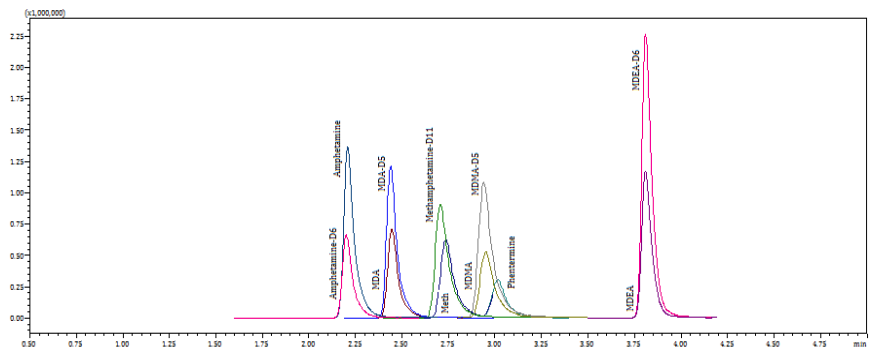
A simple and robust solid-phase extraction (SPE) procedure for amphetamines in blood, plasma/serum, urine and tissue samples. The mixed-mode functionality of the Clean Screen® DAU SPE cartridge ensures efficient extraction of the amphetamines while removing undesired matrix components and yielding clean extracts. UHPLC separation was carried out using a Selectra® PFPP column prior to detection by tandem mass spectrometry (MS/MS). The PFPP (pentafluorophenylpropyl) stationary phase can undergo dipole–dipole and pi–pi interactions, imparting unique selectivity and retention mechanisms to the column that distinguish it from other stationary phases.
SPE Procedure:
-
Sample Preparation:
• Add appropriate volumes of internal standard to 1 -2 mL of blood, plasma/ serum, urine, or 1 g (1:4) tissue homogenate
• Mix/vortex briefly and let stand for 5 minutes
• Add 3 mL of 100 mM phosphate buffer (pH 6.0)
• Mix/vortex briefly
• For blood, plasma/ serum tissue homogenate samples, centrifuge for 10 minutes at 2000 rpm (discard pellet after loading sample onto SPE cartridge) -
Condition SPE Sorbent:
• 1 x 3 mL methanol
• 1 x 3 mL 100 mM phosphate buffer (pH 6.0) -
Apply sample:
• Load sample at 1-2 mL/minute -
Wash Sorbent:
• 1 x 3 mL 0.1 M HCl
• 1 x 3 mL methanol -
Dry Sorbent:
• Dry SPE cartridge for 2 mins at 80-100 psi -
Elute:
• 1 x 3 mL ethyl acetate/ IPA/ NH4OH (78:20:2)
• Collect eluate at 1-2 mL/minute -
Evaporate Eluent:
• Evaporate the eluent for 5 minutes to remove NH4OH (40°C, gentle stream of N2)
• Add 100 µL of 1% HCl in methanol to prevent volatization of the drugs and loss during evaporation
Note: it is important to remove the NH4OH prior to adding 1% HCl in methanol, otherwise a white precipitate (NH4Cl) will form. -
Reconstitute:
• Reconstitute samples in 100 µL of mobile phase (alternative volumes may also be used)
Instrument: |
Shimadzu LCMS-8050 |
UHPLC Column: |
Selectra® PFPP (50 X 2.1 mm, 1.8 µm) |
Guard Column: |
Selectra® PFPP (10 X 2.0 mm, 1.8 µm) |
Temp.: |
40 0C |
Gradient: |
Initial: 100% A - 0% B
|