Thermo Guide #
The following tables list a series of commonly used HPLC solvents and their most pertinent physical properties, including viscosity and miscibility number. The miscibility numbers can be used to predict the miscibility of solvents.
If the smaller miscibility number is subtracted from the larger and the difference is 15 units or less, then the two liquids are soluble in all proportions at 15 °C. 15^0C
If the smaller miscibility number is subtracted from the larger and the difference is 16 units, then the two liquids have a critical solution temperature between 25 and 75 °C with 50 °C as the optimum temperature.
If the smaller miscibility number is subtracted from the larger and the difference is 17 or greater, then the two liquids are immiscible, or their critical temperature is greater than 75 °C.
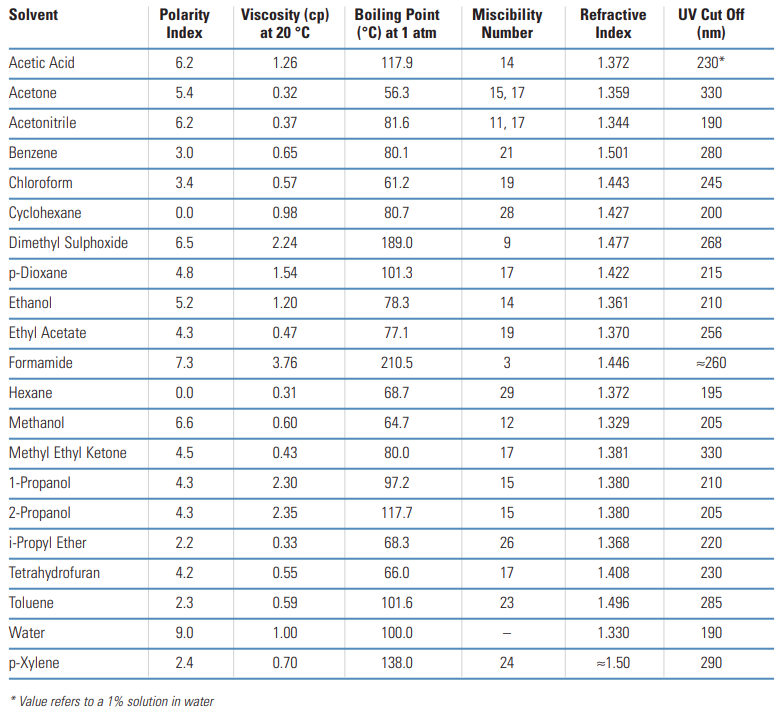
Note: Solvents that have a double miscibility number are immiscible with other solvents at extremes of the lipophilicity scale. The lower of the two numbers relates to solvents with high lipophilicity and the second to solvents with low lipophilicity. Important: molecular interaction (hydrogen bonding for example) between liquids can change the expected level of miscibility.
Solvents with double miscibility numbers can, in some circumstances, be immiscible with each other.
Sigma-Aldrich Guide #
Solvent | Polarity | Miscibility Number | UV Cutoff (nm)• | Refractive Index at 20 °C | Solvent Strength, ∈o (silica) | Viscosity at 20 °C, cP |
|---|---|---|---|---|---|---|
2-Propanol | 4.3 | 15 | 210 | 1.377 | 0.63 | 2.3 |
Acetonitrile | 6.2 | 11, 17 | 190 | 1.344 | 0.5 | 0.37 |
Ethyl acetate | 4.3 | 19 | 260 | 1.372 | 0.45 | 0.45 |
Hexane | 0.0 | 29 | 200 | 1.375 | 0 | 0.33 |
Methanol | 6.6 | 12 | 205 | 1.329 | 0.73 | 0.6 |
Water | 9.0 | - | -- | 1.3328 | >0.73 | 1 |
Note: values of polarity and miscibility number in this table are derived from table 1 above.
• Typical values.