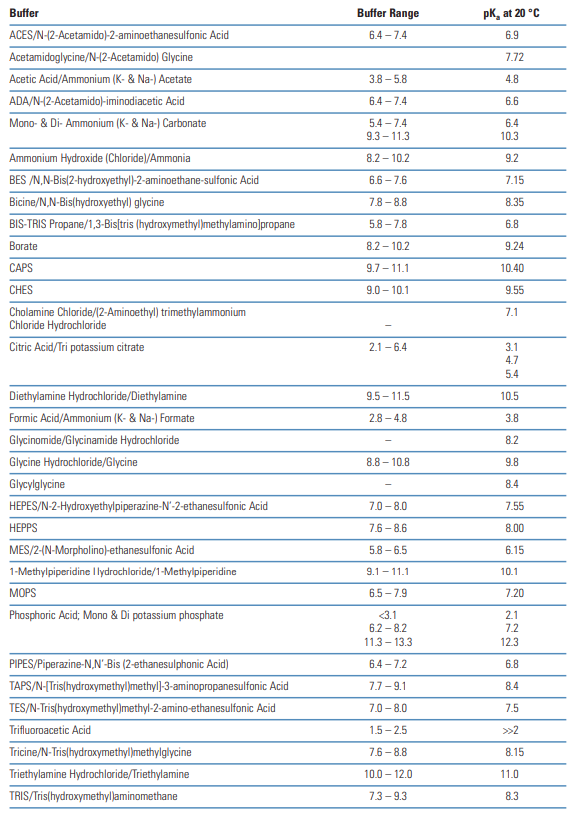
Buffer choice will be very dependent on the analyte and the instrumentation used. Ideally, LC/MS applications should use a volatile buffer as this will not form a contaminating deposit on the cone and source. Inorganic acids, involatile buffers and ion-pair reagents should all be avoided. Typical LC/MS buffers include:
• Ammonium acetate/formate/hydrogen carbonate (<50mM)
• Formic/acetic acid (0.01 – 1% v/v)
• Trifluoroacetic acid (<0.1% v/v)
• Trialkylamine and aqueous ammonia type bases
• TRIS
• BIS-TRIS propane
Electrolyte additives are often added to LC/MS buffers to improve peak shape. These additives should also be volatile. Care should be taken when choosing a buffer and additive mixture to ensure that a solution of the two does not produce a solid salt which could cause system contamination.
Buffers should always be flushed from the analytical column and instrument after use to avoid salts being deposited on delicate frits etc.
Note: There are LC/MS instruments available which incorporate a self-cleaning mechanism to reduce the build up of inorganic buffers etc. during routine use. Care should still be taken not to purposefully over-contaminate the instrument source as this will lead to operating difficulties.