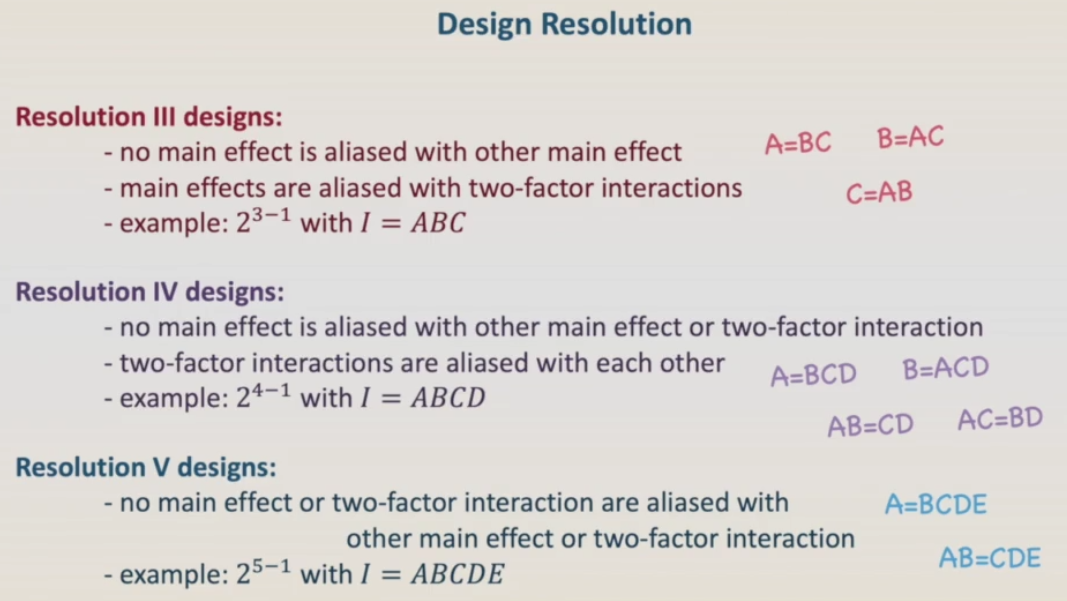
The aliases of a design define the design resolution. In Resolution III designs, We have that no main effect is aliased with other main effects, but main effects are aliased with two-factor interactions. For example, a two in the power of three minus one with identity ABC. As we have already seen A is aliased to BC, B is aliased to AC, and C is aliased to AB.
In Resolution IV designs, no main effect is aliased to other main effect or two-factor interactions. However, two-factor interactions are aliased to each other. For example, a two in the power of four minus one design with identity ABCD. In this example, the main factor A is aliased to the three-factor interaction BCD, B with ACD and the two-factor interactions AB with CD, AC with BD and so on.
And finally, in Resolution V designs, no main effect or two-factor interaction are aliased with other main effect or two-factor interaction. For example, a two in the power of five minus one design with identity ABCDE. In this case we have the main factor A aliased to the four-factor interaction BCDE, the two-factor interaction AB aliased to the three-factor interaction CDE and so on.
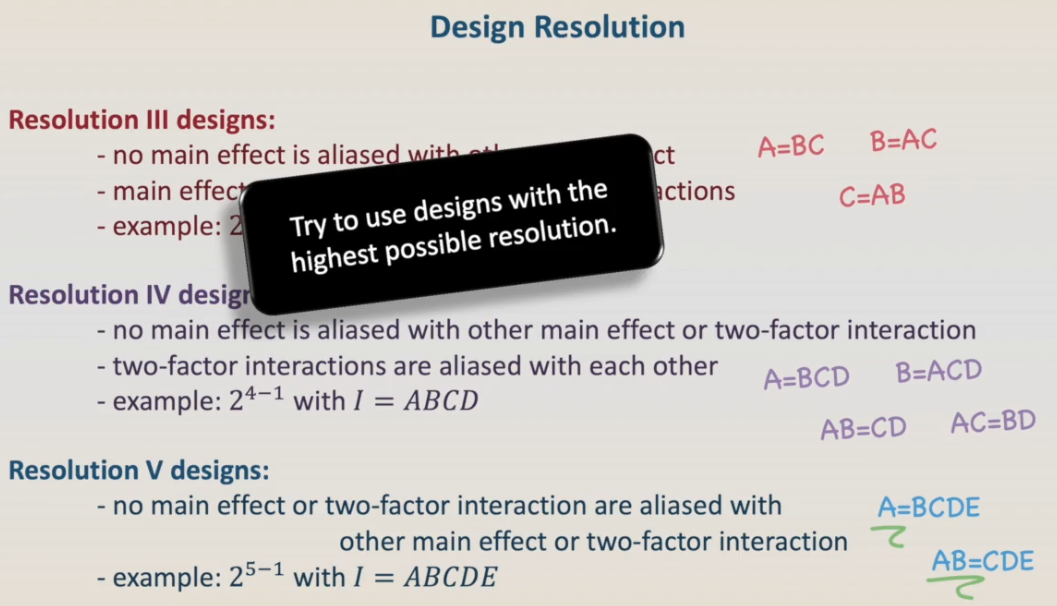
We always try to employ fractional designs with the highest possible resolution. The higher the resolution, the less restrictive the assumptions that are required regarding which of the interactions are negligible to obtain a unique interpretation of the results. For instance, in resolution three designs we are assuming that two factor interactions are not significant. And this is a very risky assumption since they have a pretty high chance of being significant. However, in resolution V designs we can easily draw conclusions regarding main factors, as they are aliased with 3-factor interactions, usually not significant, but it's hard to draw final conclusions about the two-factor interactions since they are aliased to each other. Finally, in resolution V designs we can draw solid conclusions about both main factors and two-factor interactions since they are aliased to high-order non-significant interactions.