Section 8: Fractional Designs
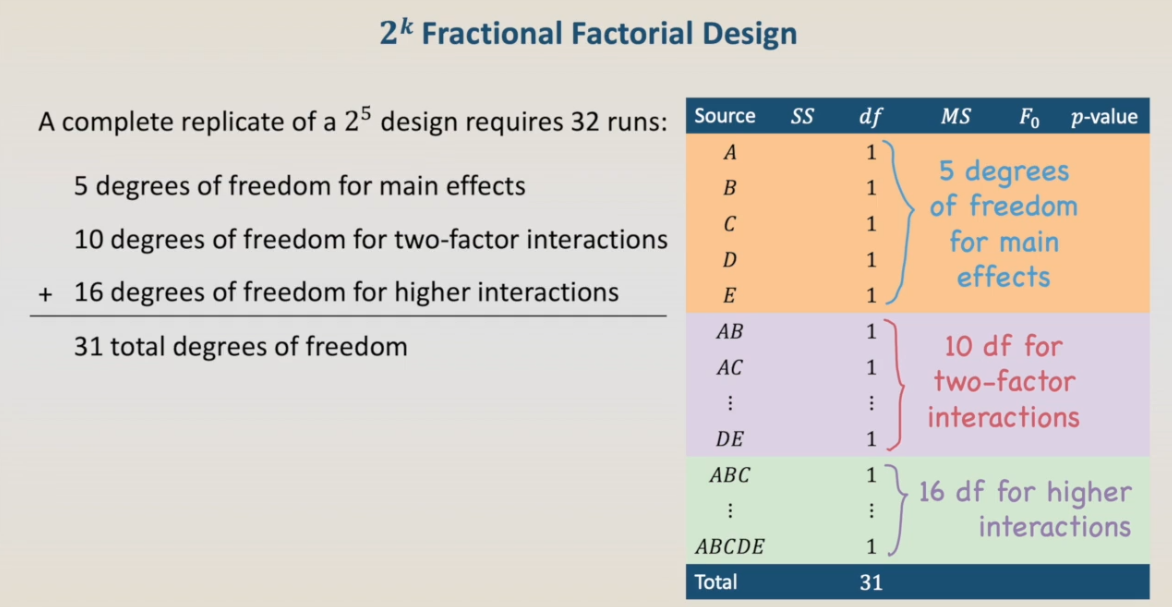
A complete replicate of a 2 in the power of 5 design requires 32 runs, with a total of 31 degrees of freedom, from which 5 degrees of freedom are related to main effects, we have 10 degrees of freedom related to two factor interactions, and the remaining 16 degrees of freedom are related to higher-order interactions.
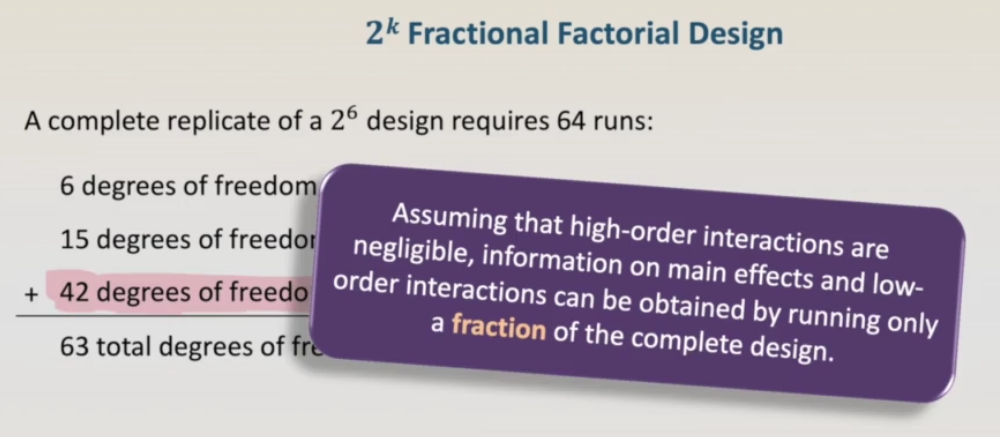
When we have a 2 in the power of 6 design, we need 64 runs for a complete replicate, with a total of 63 degrees of freedom, from which 42 are related to higher-order interactions. In these cases, assuming that the high order interactions are negligible, the information on main effects and low-order interactions can be obtained by running only a fraction of the complete design.
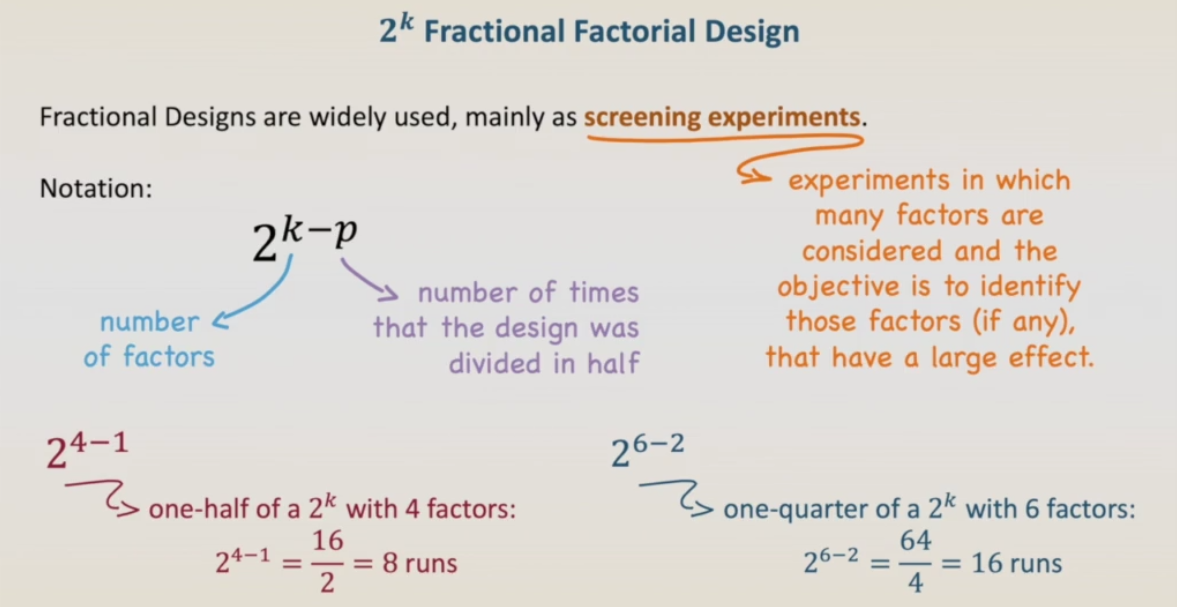
Fractional designs are widely used mainly as a screening experiments, that are experiments in which many factors are being considered and objective is to identify those factors that have a large effect on the response. The notation is 2 in the power of
k minus
p, where
k is the number of factors and
p is the number of times that the design was divided in half. For example, a 2 in the power of 4 minus 1 design means a 1/2 fraction of a 2 in the power of k design with 4 factors, in a total of eight runs. A 2 in the power of 6 minus 2 design means 1/4 of a 2 in the power of K design with six factors, with a total of 16 runs.
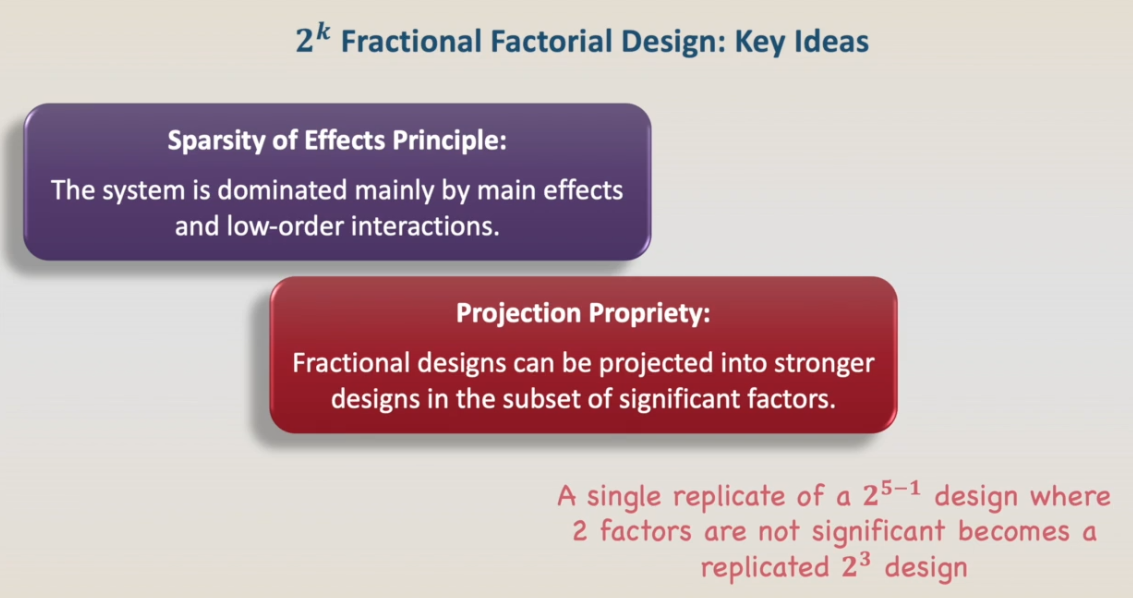
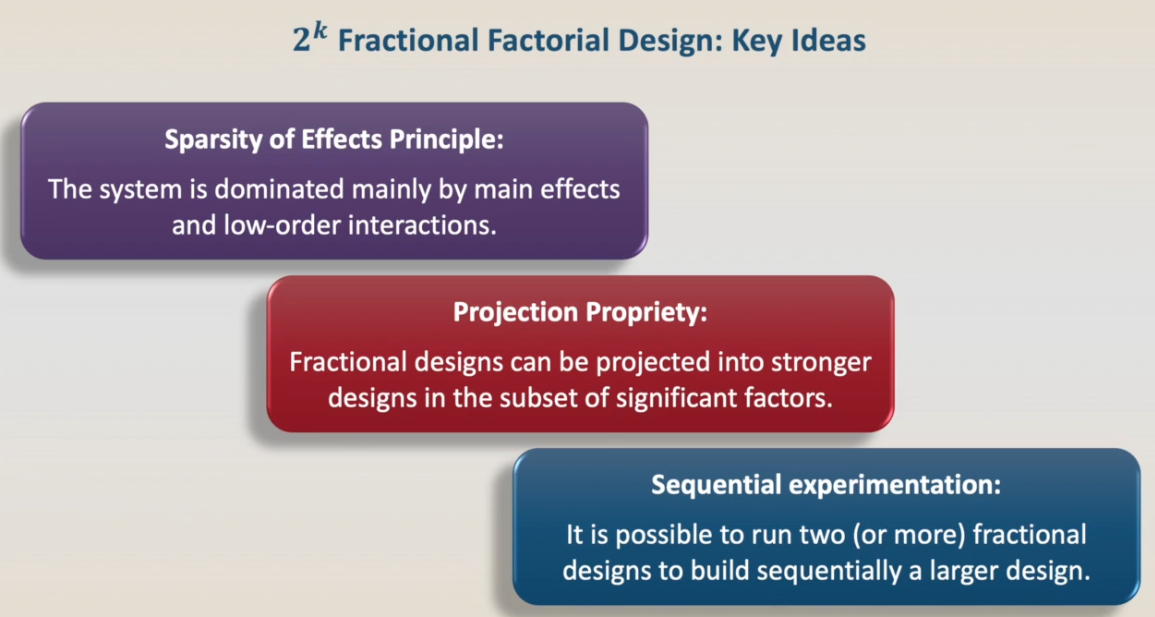
There are some key ideas behind the fractional factorial designs. The first is the sparsity of effects principle, that we have already used in the single replicate designs: the systems are dominated mainly by main effects and low order interactions, so we can use the high order interactions to estimate the error. Then we have the projection property: fractional designs can be projected into stronger designs in the subset of significant factors. For example, a single replicate of a 2 in the power of 5 minus 1 design where two factors are not significant, becomes a replicated two in the power of three design.
And finally: the sequential experimentation it is possible to run 2 or more fractional designs to build, sequentially, a larger design, sometimes a complete design.