Goal
It is about planning, conducting experiments, and analyzing the resulting data so that valid and objective conclusions are attained.
Statistical design of experiments refers to the process of planning the experiment so the appropriate data will be collected and analysed by statistical methods, resulting in valid and objective conclusions.
When the problem involves data that are subject to experimental errors, statistical methods are the only objective approach to analysis.
Basic principles of the design of experiments
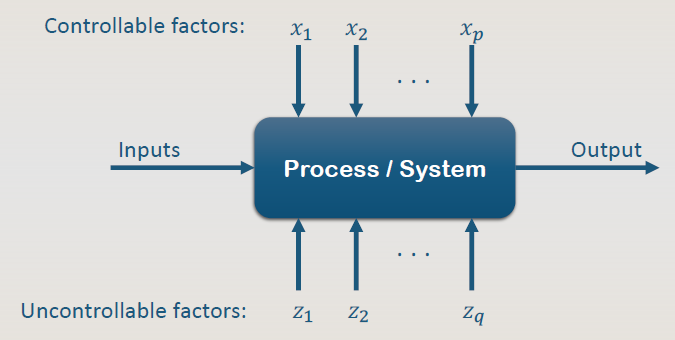
Randomization: It means that both the allocation of experimental material and the order in which the individual runs will be performed are randomly determined.
Randomization is the cornerstone underlying the use of statistical methods in the experimental design. It assures that errors are independently distributed among the runs.
Replication: It means an independent repeat run of each factor combination. It does not refer to repeated runs. Replications reflect the sources of variability of the system.
Blocking: It is used to eliminate the variability transmitted by nuisance factors. A block is a set of relatively homogeneous experimental conditions.