series: [Analysis of Pesticides in Food and Environmental Samples, edited by Jose L. Tadeo]
SPE Application [1] #
SPE is a cleanup technique. SPE columns are typically in the 10–50 theoretical plate range.
Two strategies have been used for SPE cleanup of sample extracts, which can be referred to as analyte isolation and matrix isolation. Analyte isolation typically entails analytes that are adsorbed from an organic solvent–water mixture onto a nonpolar SPE sorbent.
The SPE column may be rinsed with an aqueous solution to remove interfering coextractives, followed by elution of the adsorbed analytes with an organic solvent.
Matrix isolation entails using the SPE columns which act as chemical filters and trapping matrix components while the pesticides are eluted through the column. Matrix isolation is more widely used in pesticide residue cleanup. Generally, matrix isolation SPE cleanup procedures are devised so that both polar and nonpolar pesticides will be eluted through the SPE column(s) while certain matrix components will be retained.
Analyte isolation using nonpolar reversed phase SPE columns (C18 or SDVB) works very well with nonpolar pesticides such as the OCs and the synthetic pyrethroids but not with polar, water-soluble pesticides, as they may not be consistently adsorbed onto nonpolar reversed phase SPE sorbents from an organic solvent–water mixture.
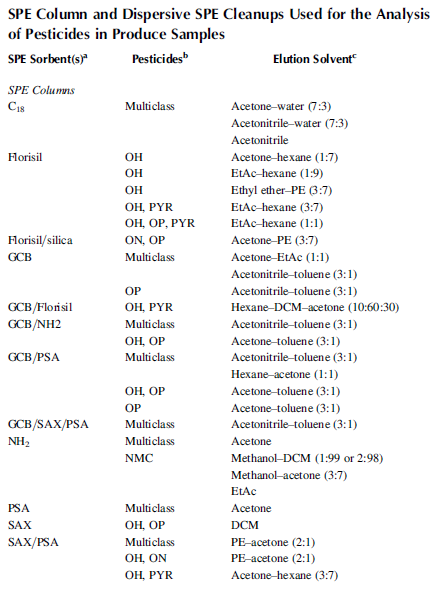
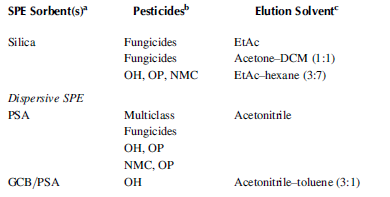
a C18, Octadecyl-derivatized silica; GCB, graphitized carbon black; NH2, aminopropyl; PSA, primary secondary amine; SAX, strong anion exchanger.
b OH, Organohalogens; ON, organonitrogens; OP, organophosphates; PYR, synthetic pyrethroids; NMC, N-methylcarbamates.
c DCM, dichloromethane; EtAc, ethyl acetate; PE, petroleum ether.
Disadvantage [2] #
There are many different types of sorbents and configurations (e.g., mass of sorbent per tube), and each SPE is inherently best suited for a specific class of pesticide compounds. This, when combined with operational factors such as flow rate, conditioning, and elution, and the effect of sample matrix, can make the recovery of pesticides highly variable.
In addition, suspended solids and salts are known to cause blockage of SPE cartridges. Samples compatible with SPE must be relatively clean (e.g., groundwater). When surface water samples are analyzed, prefiltration is generally necessary to remove the suspended solids. This may not be desirable for hydrophobic compounds, because a significant fraction of the analyte is associated with the suspended solids.
Reference #
[1] p158, Analysis of Pesticides in Food and Environmental Samples, Jose L. Tadeo
[2] p238, Analysis of Pesticides in Food and Environmental Samples, Jose L. Tadeo