Evaluation Approaches: #
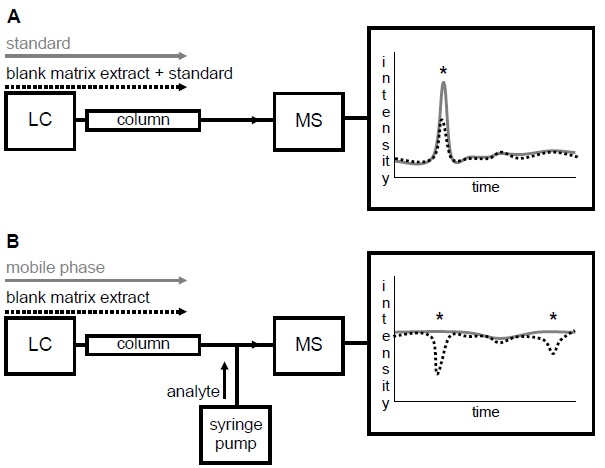
To evaluate matrix effects, two approaches are commonly used: 1) a post-extraction addition method and 2) post-column infusion method.
In the post-extraction addition method, matrix effects (ME), recovery (RE) and overall process efficiency (PE) can be determined by comparing the response of a standard solution, a pre-extraction spiked sample and a post-extraction spiked sample (fig. 1A).
In the post-column infusion system, matrix effects are determined by comparing the signal of a blank sample and a blank matrix extract which are injected into the LC system while the analyte is continuously infused into the column eluent before entering the mass spectrometer (fig. 1B).
Post-column infusion gives qualitative information about the matrix effects during the entire chromatographic run, while the post-extraction addition approach gives quantitative information, but only at the time of elution.
More recently, an approach using comparison of the precision of slopes of calibration curves generated in different sources was described. This method is less labour intensive as calibration curves from linearity experiments can be used. However only the variability of the overall process efficiency can be determined and not the values or variability of matrix effects and recovery separately.
Reference: #
LC-MS/MS in forensix toxicology: What about matrix effects? Jan, 2011, Ruth Verplaetse