series: [Applications in High Resolution Mass Spectrometrey Food Safety and Pesticide Residue Analysis edited by Roberto Romero-Gonzalez]
The principle of Orbitrap is based on the Kingdon ion trap described in 1923 (Kingdon, 1923, p. 408). It was a trapping device consisting of a charged wire stretched along the axis of an enclosed metal can. The wire establishes an electrostatic field within the can, and ions that possess sufficiently high tangential velocity orbit the wire, rather than directly colliding with it (Eliuk & Makarov, 2015, p. 61).
A thorough explanation of the mass analysis process is detailed elsewhere (Eliuk & Makarov, 2015, p. 61). This mass analyzer is based on the confinement of ions in an electrostatic potential well (Makarov, 1999, US 5886346; Makarov, 2000, p. 1156; Makarov & Hardman, 2006, US 6998609 B2) created between two carefully shaped electrodes: an inner coaxial spindled-shaped electrode and an outer (barrellike) electrode, which is actually composed of two symmetrical halves electrically isolated from each other, set out for two purposes: establishment of the ion trapping fields and as receiver plates for image-current detection.
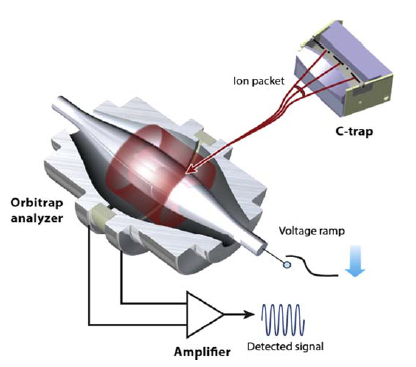
Figure : Cross section of the C-trap ion accumulation device and the Orbitrap mass analyzer with an example of an ion trajectory. During the voltage ramp, the ion packets enter the Orbitrap mass analyzer forming rings that induce current which is detected by the amplifier.
The electrodes are precisely machined so that the electrostatic attractions of the ions to inner electrode are finely balanced by centrifugal forces, which cause the ions to orbit around the spindle. Previously, ions are first accumulated on an external injecting device (C-trap) that traps the ions in gas-filled quadrupole being then injected tangentially into the mass analyzer in short pulses (Fig.). Besides, an axial field causes the ions to oscillate harmonically along the spindled-shaped electrode. The outer electrodes allow differential image-current detection. These image currents produced by the oscillating ions are detected, followed by a fast Fourier transform (FT) to convert the time-domain signal to frequency domain and then to m/z spectrum. Here the resolution is directly proportional to number of harmonic oscillations detected. The resolving power can be enhanced by increasing the gap between inner and outer electrodes providing higher field strength for a given voltage. As the maximum acquisition time is limited in Orbitrap, the resolution power is not as high as FT-ICR. However, commercial Orbitrap analyzer provides a nominal resolution power as high as 500,000 at FWHM.
p21, Applications in High Resolution Mass Spectrometrey Food Safety and Pesticide Residue Analysis, edited by Roberto Romero-González, ©2017 ELSEVIER.