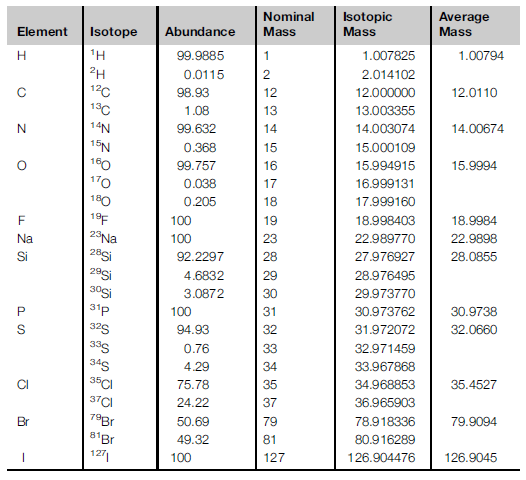
• Atomic mass: The number that represents the element’s mass based on the weighted average of the masses of its naturally occurring stable isotopes. For example, the integer atomic mass of bromine is 80 Da. This is because there are only two naturally occurring stable isotopes of bromine, 79Br and 81Br, which exist in nature in about equal amounts. When the relative mass (Mr) of an ion, molecule, or radical is reported, it is based on the atomic masses of its elements.
• Nominal mass: Mass of a molecular ion or molecule calculated using the isotope mass of the most abundant constituent element isotope of each element rounded to the nearest integer value and multiplied by the number of atoms of each element. Example: nominal mass of H2O = (2 $\times$ 1 + 1 $\times$ 16) u = 18 u.
• Monoisotopic mass: Exact mass of an ion or molecule calculated using the mass of the most abundant isotope of each element. Example: monoisotopic mass of H2O = (2 $\times$ 1.007825 + 1 $\times$ 15.994915) u = 18.010565 u. The exact mass of the common elements and their isotopes are provided in Table 1.1.
• Exact mass: Calculated mass of an ion or molecule with specified isotopic composition.
• Mass defect: Difference between the nominal mass and the monoisotopic mass of an atom, molecule, or ion. It can be a positive or negative value.
• Relative isotopic mass defect (RΔm): It is the mass defect between the monoisotopic mass of an element and the mass of its A+1 or its A+2 isotopic cluster (Thurman & Ferrer, 2010). For instance, RDm for the pair 35Cl:37Cl is 0.0030 Da.
• Average mass: Mass of an ion or molecule weighted for its isotopic composition, i.e., the average of the isotopic masses of each element, weighted for isotopic abundance (Table 1.1). Example: average mass of H2O = (2 $\times$ 1.00794 + 1 $\times$ 15.9994) u = 18.01528 u.
• Accurate mass: Experimentally determined mass of an ion of known charge.
• Mass accuracy: Difference between the mass measured by the mass analyzer and theoretical value.
• Resolution or mass resolving power: Measure of the ability of a mass analyzer to distinguish two signals of slightly different m/z ratios.
• Mass calibration: Means of determining m/z values of ions from experimentally detected signals using a theoretical or empirical relational equation. In general, this is accomplished using a computer-based data system and a calibration file obtained from a mass spectrum of a compound that produces ions of known m/z values.
• Mass limit: Value of m/z above or below which ions cannot be detected in a mass spectrometer.
• Mass numbe*r: The sum of the protons and neutrons in an atom, molecule, or ion. If the mass is expressed in u, mass number is similar to nominal mass.
• Most abundant ion mass: The mass that corresponds to the most abundant peak in the isotopic cluster of the ion of a given empirical formula.