The IUPAC recommendations (Murray et al., 2013) define resolution as m/Δm, where m is the m/z of the ion of interest. Although depending on the method of measurement of Δ(m/z), it is possible to differentiate between the two concepts (Murray et al., 2013; Price, 1991).
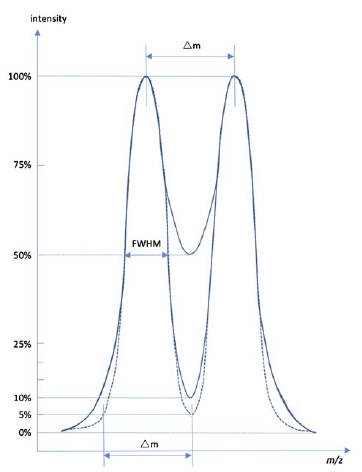
On one hand, resolution, as 10% valley, is the (m/z)/Δ(m/z) value measured for two peaks of equal height in a mass spectrum at m/z and m/ z + Δ(m/z) that are separated by a valley for which the lowest point is 10% of the height of either peak, i.e., the peaks are resolved when the valley between the two m/z values is 10% of the height of either one (Fig. 1.1). For peaks of similar height separated by a valley, let the height of the valley at its lowest point be 10% of the lower peak, and the resolution should be given for a number of values of m/z. This 10% valley definition for the resolution is used with magnetic-sector analyzers (Ekman et al., 2009).
On the other hand, resolution, as peak width, expresses the (m/z)/Δ(m/z) value for a single peak, where Δ(m/z) is the width of the peak at a height, which is a specified fraction (50, 5, or 0.5%) of its maximum peak height (Fig. 1.1). The used fraction is often 50%, and Δ(m/z) is named as full width at half maximum (FWHM). FT-ICR, TOF, and Orbitrap analyzers use this 50% valley definition for set resolution (Ekman et al., 2009).