Fundamentals of Mass Spectrometry provided by Waters (1 of 7)
Electrospray ionization, commonly referred to as ESI, is an example of an atmospheric pressure ionization (API) technique.
In the ESI source, the electric field is sufficient enough so that small droplets (solvated ions) turned to desolvated ions.
In contrast to vacuum ionization techniques, such as electron ionization or EI, ESI is considered to be a soft ionization technique, this is because ESI typically produces intact ions related to the analyte molecule and fewer fragment ions than vacuum ionization techniques.
EI produces positive ions, while ESI produces positive and negative ions.
Hi, my name is Helen, I work at Waters Corporation as an analytical scientist. So I’m going to talk about electrospray ionization.
Electrospray ionization, commonly referred to as ESI, is an example of an atmospheric pressure ionization (API) technique. Other examples include atmospheric pressure chemical ionization or APCI, and atmospheric pressure photo ionization or APPI.
ESI for LCMS, in its current form, was formally proposed by John Fenn and his coworker Masamichi Yamashita in the early 1980s. But process is very similar to ESI are observed and reported as far back as 1914, and even earlier.
ESI Structure #
In an ESI ion source, a narrow metal capillary is held at high voltage and a potential difference is produced between the capillary and the orifice at the mass spectrometer. A solution containing analyte ions, often an LC eluent, is sprayed from the capillary. Usually a flow of gas is also employed to more efficiently nebulize or break up the liquid stream into tiny droplets.
What Does ESI Do? #
ESI requires the formation of ions in solution prior to the transfer of the gas phase. Typically, molecules are believed to undergo electrochemical reactions, either through redox reactions at the liquid metal interface of the capillary tip or through acid base reactions in solution.
The exact mechanism by which ions are transferred in the gas phase is still a matter for debate and ongoing research. But two main processes have been proposed.
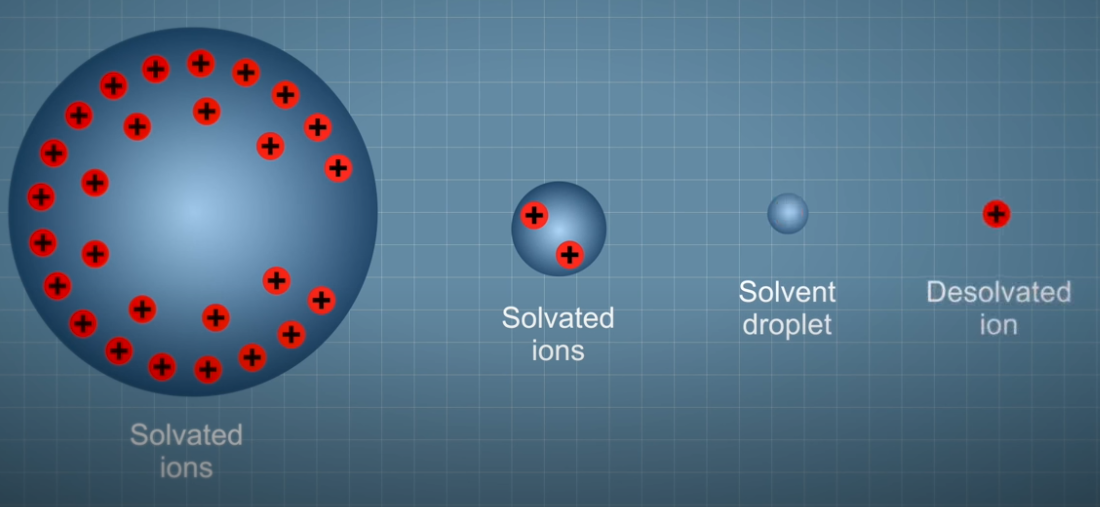
- The Ion evaporation mechanism (IEM), where the electric field of the surface of highly charged small droplets become sufficient to yield desorbed ions directly from the surface. In this process, solvated ions leave the larger droplets sequentially, and the droplet shrinks until just desolvated ions remain.
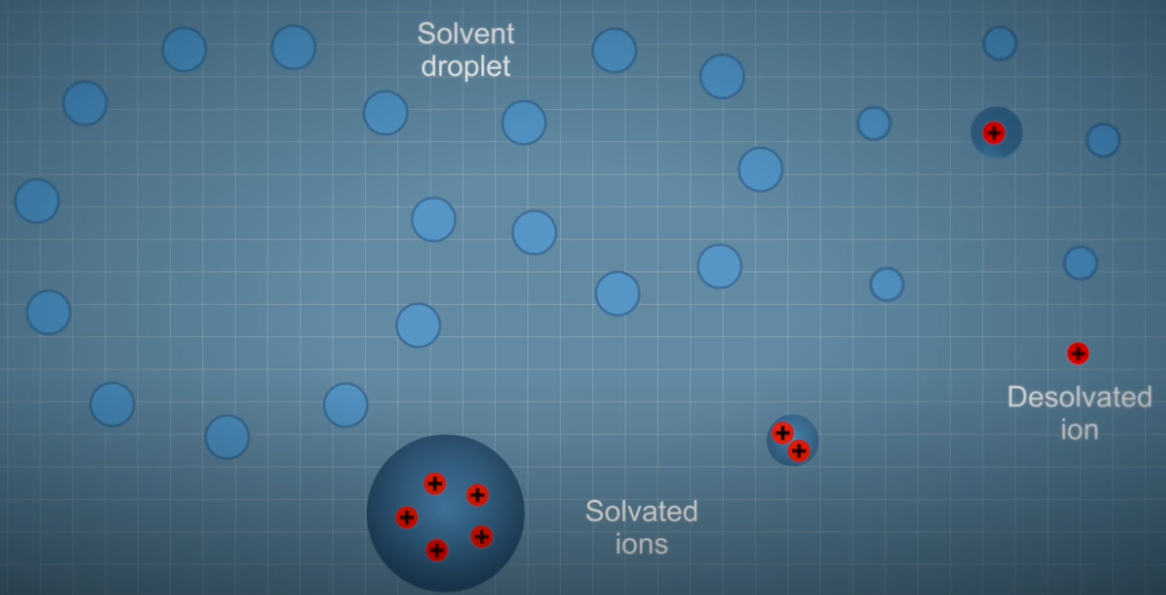 2) For the charged residue module CRM where ions eventually become desolvated as solvent molecules leave the droplet surface. In this process, solvent molecules evaporate from the larger droplet and the droplet shrinks until just the desolvated ions remain.
Evidence suggests that smaller ions are more likely to enter the gas phase by the IEM whereas larger multiple charged species are more likely to follow the CRM. Modifications or related processes to these two mechanisms have also been proposed.
The Difference between EI and ESI #
In contrast to vacuum ionization techniques, such as electron ionization or EI as it’s usually known, ESI is considered to be a soft ionization technique. This is because ESI typically produces intact ions related to the analyte molecule and fewer fragment ions than vacuum ionization techniques.
In EI to form positive ions high energy electrons in packed with the analyte molecules, knocking an electrode from the outer shell of the molecule and typically imparting enough energy to break up the molecular ion to produce fragment ions.
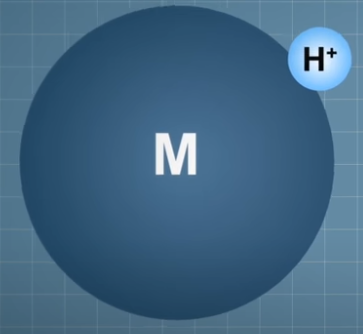 In ESI, to form positive ions, cations. For example, hydrogen ions often just called protons interact with the analyte molecules and form new bonds between the cations and the analyte molecules. This produces adduct ions also sometimes called cationized molecules, with a total mass equal to the mass of the analyte molecule plus the mass of the cation.
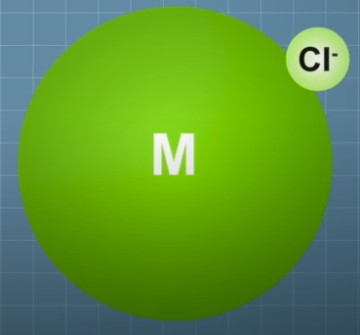 It is also possible to form negative ions in ESI by forming adduct ions with anions, such as chloride ions, negative ions and ESI can also be formed by other processes such as proton abstraction, in which a proton is removed from an analyte molecule to leave a negatively charged ion.
Close #
You can learn more about these processes in the video covering add information. For background reading further information about ESI you could take a look at these references.